





How to get direct bookings for your vacation rental and stop paying high OTA commissions

Every reservation that arrives through Booking.com or Airbnb has a cost attached. It is not visible upfront because it is deducted from your payout, not from what the guest pays. But add it up at the end of the season and the number is not insignificant.
On €20,000 in seasonal revenue, just one platform takes more than €3,000. Two platforms, twice. Guests arrive, the property is full, business is running. But part of that money never reaches you.
There is a systematic solution: a direct booking channel. The guest books through your website, no commission applies, and the money stays with you. In this guide you will learn exactly what you are paying, what a Booking Engine is, and how to build a direct channel that guests actually use.
What do Booking.com and Airbnb actually take from each of your reservations?
An OTA commission is the percentage a platform takes from every confirmed reservation. You do not pay upfront or a flat monthly fee. You pay per reservation, out of your revenue.

Booking.com charges a commission on every eligible reservation. It is not a flat fee but a percentage of the total booking value. According to Booking.com partner documentation, the global average is 15%, with a range from 10% to 25% depending on market position, property type, and visibility level on the platform.
Airbnb operates on two fee models. Without property management software, it uses a split fee structure: the host pays 3% and the guest pays a separate fee of 14.1% to 16.5%. The moment you use a Channel Manager or PMS, Airbnb automatically places you in the simple fee category at 15.5%. The host pays everything, the guest sees no separate fee.Što to znači u eurima?
| Seasonal revenue | Booking.com (15%) | Airbnb s CM (15,5%) | Total, both platforms |
|---|---|---|---|
| 10,000 EUR | 1,500 EUR | 1,550 EUR | 3,050 EUR |
| 20,000 EUR | 3,000 EUR | 3,100 EUR | 6,100 EUR |
| 30,000 EUR | 4,500 EUR | 4,650 EUR | 9,150 EUR |
On €20,000 in revenue per platform, more than €3,000 leaves your pocket every year. Every direct booking keeps that amount with you.
What is a direct booking and how is it different from an OTA reservation?
A direct booking happens when a guest reserves your vacation rental through your own website, without an OTA intermediary. No commission, no revenue sharing. The guest pays you, and you receive the full amount.

An OTA reservation goes through a middleman. Booking.com or Airbnb displays your listing, the guest books on their platform, they confirm the reservation and take their commission before paying out the remainder to you.
Why guests sometimes prefer booking directly?
- Lower total price because they do not pay the Airbnb guest service fee on top
- Direct contact with you, easier communication around specific requests
- More flexible cancellation terms that you can negotiate directly
- Returning guests who already know your property have no reason to go through an OTA
A direct booking is not just cheaper for you. It is often better value for the guest too. This is a channel where both sides benefit.
What is a Booking Engine and why is a contact form not the same thing?
A Booking Engine is a tool that lets guests check availability, select dates, and complete a reservation directly on your website, with automatic calendar synchronization and booking confirmation. It is not complicated to set up, and over time direct bookings become the most cost-effective reservations you can get.
The difference from a contact form matters. A contact form is manual work: the guest asks about availability, you check the calendar, you reply, you wait for confirmation, you arrange payment. Every step requires your time. A Booking Engine automates the entire process: the guest checks availability, selects dates, pays, and receives confirmation. No waiting, no back-and-forth, no manual input from you.

The key technical difference: a Booking Engine is connected to the same central calendar as your OTA channels. When a guest books directly, the dates are automatically closed on Booking.com, Airbnb, and all other connected platforms. No double booking risk.
A contact form is a starting point for a conversation. A Booking Engine is an automated sales channel that works without you being present.i.
How to build a direct booking channel step by step?
Building a direct booking channel is not a large project. For vacation rental owners moving away from full OTA dependence, here is the practical order of steps:
- Add a booking engine to your website. Rentlio Booking Engine integrates directly with your existing website. Guests see live availability and can complete a reservation without leaving for an OTA.
- Connect everything to one central calendar. All channels, Booking.com, Airbnb, and direct bookings, must share the same calendar. One availability change updates everywhere. No double bookings.
- Define your direct booking offer. Give guests a reason to book directly. A 5% discount, a free early check-in, a welcome package, or more flexible cancellation terms all work. It does not need to be costly.
- Set up automated follow-up messages. After checkout, every guest should receive a short message with a link to your website and an invitation to book directly next time. This is the most cost-effective way to grow your direct channel over time.

A direct booking channel does not appear overnight but it builds systematically. Every returning guest who books directly next time is a permanent saving.
How to encourage guests to book directly instead of through OTAs
The most common reason guests do not book directly is not lack of interest but lack of opportunity. If they do not know you accept direct bookings, they will not try. Here are practical tactics:
- A small discount or perk. A 5% discount for direct bookings or a complimentary late checkout is often enough. The guest saves money, and you still earn more than through an OTA after commission.
- A personalized post-stay message. "Thank you for staying with us. Next time, book directly at [link] and get [perk]." Short, specific, and useful.
- Your website link in every communication. Booking confirmation, arrival instructions, welcome message. Every guest touchpoint is an opportunity for them to learn where to book directly.
- A loyalty reminder for returning guests. A guest who has already stayed with you knows what they are getting. A reminder with a link and a small offer is usually enough.

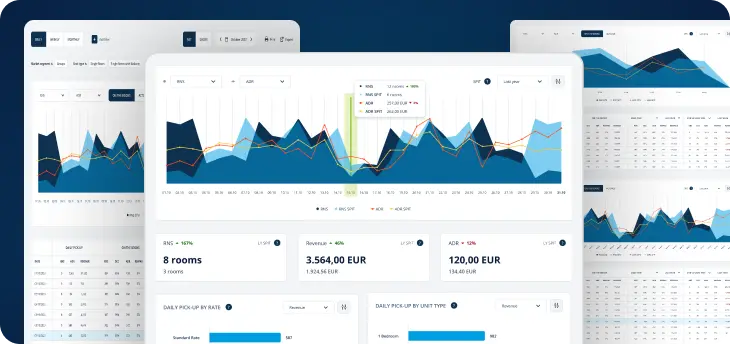
Vacation rental owners using Rentlio One have all of these automations in one place: automated guest messages, a Booking Engine connected to the central calendar, and a revenue dashboard showing which channels generate the most income.
Direct bookings do not happen on their own. They happen when a guest has both a reason and a way to book directly. You can control both.
Booking Engine vs. OTA: do you need both?
A direct booking channel is not a replacement for OTAs. It is a complement to them.
OTA platforms are indispensable for acquiring new guests. Booking.com and Airbnb have millions of users who would never find your website on their own. For first-time guests, for filling open dates, for international travelers searching your destination, OTAs are the most efficient discovery channel you have.
But every guest who arrives through an OTA becomes a potential direct booker. Returning guests who already know your property have no reason to pay OTA prices when they can book directly, often at a lower total cost.
The math shifts over time. In year one, maybe 80% of your bookings come through OTAs and 20% directly. By year three, with a systematic direct channel in place, that ratio can move toward 60/40 or better, which means significantly more revenue staying with you each season.
OTAs bring you new guests, your direct channel retains the returning ones. Both are necessary, but together they build a revenue structure that is healthier every season.
Ready to build your own booking channel?
More than 1,700 properties across the region already use Rentlio. Booking Engine, Channel Manager, automated guest communication, and revenue dashboard, all in one app.
The 2026 season is coming up. Book a free meeting and see how Rentlio One works for your property.
Frequently asked questions (FAQ)
Can I have a Booking Engine without my own website?
Yes. Rentlio allows you to set up a Booking Engine as a standalone reservations page, without a full website. That said, having your own website increases trust and conversion because guests can see full property details before booking.
Will Booking.com penalize me for promoting direct bookings?
Booking.com does not penalize properties for having a direct booking channel, and it is a legal and common practice. As long as you maintain a strong rating and occupancy through their platform, your visibility will not be affected. The key is not offering significantly lower prices direct than on Booking.com, as this can conflict with rate parity terms in some agreements.
How does a guest pay for a direct booking?
Depending on your setup, guests can pay by card online at the time of booking or in person on arrival. Rentlio supports online payment through integrated billing. You define the payment terms.
How long does it take to set up a Booking Engine in Rentlio?
For vacation rental owners already using Rentlio One, setting up the Booking Engine takes a few hours. The support team walks you through onboarding step by step at no extra cost.
What if a guest wants to cancel a direct booking?
You define the cancellation terms. This is one of the key advantages of direct bookings: you have full control over cancellation policy, unlike OTAs where the platform imposes standard conditions.
Is a direct booking safe for the guest?
Yes, if you use a reliable Booking Engine with an SSL certificate and secure payment processing. The Rentlio Booking Engine meets all current security standards. The guest receives a booking confirmation by email, has direct contact with you, and sees clear cancellation terms before completing the reservation.
How do I get more direct bookings if I am just starting out?
Start by activating a Booking Engine on your website and mentioning it in post-stay messages to guests. Offer a small incentive for direct bookings, such as a 5% discount or a free early check-in. Even redirecting 20% of your OTA bookings to direct makes a meaningful financial difference by the end of the season.


Daniel Herman is a growth marketing enthusiast with 10 years of marketing experience who enjoys thinking strategically and seeing the bigger picture. He writes about everything related to developing marketing activities and KPIs, branding, and taking a long-term approach to success, always with the goal of sharing useful ideas and inspiring action.