



Airbnb is raising its fee to 15.5%. How much of each booking do you keep?

Softer demand, more competition and more cautious guests are already putting pressure on hosts. Now an extra cost is arriving too. Airbnb is switching to a new fee model in which hosts, instead of the previous roughly 3%, pay a 15.5% commission.
For years, a lower fee was one of the main reasons many hosts in Croatia chose Airbnb. The guest paid the larger part of the fee, while the host was left with a much smaller cost. With the new model, the entire fee shifts onto the host.

You cannot influence the change itself, but you can reduce its impact on your earnings. First, three things to understand:
- The fee rises from roughly 3% to 15.5% - the whole cost now falls on the host, not the guest.
- VAT is charged on the fee too - on top of the fee you also pay 25% VAT, so the real cost is even higher.
- Raising your price is not the only option - you can move part of your bookings to a direct channel, where the host keeps a much larger share of the revenue.
1. What exactly is changing and how much does it really cost?
Airbnb has so far used a split fee model. The host paid about 3%, while the guest paid the larger part of the fee at the time of booking.
From 13 October that model is being removed and Airbnb is moving to a single 15.5% fee paid entirely by the host. The guest then sees the final booking price straight away. The deadlines have already shifted, and for some hosts the new model may take effect even earlier, especially if they use software to sync prices and availability.

The difference is easiest to see with a concrete example.
Take a vacation rental that generates €3,000 in monthly revenue. Under the old model, Airbnb's fee would be about €90. With 25% VAT on the fee, the total cost would be €112.50.
Under the new model, the fee is €465. Once €116.25 of VAT is added, the total cost rises to €581.25.
On the same €3,000 in revenue, the host will therefore pay €468.75 more than before.
VAT also has to be taken into account. Hosts who are not in the regular VAT system still have to calculate and pay 25% Croatian VAT on the fee of the foreign platform. As the fee rises, so does the VAT, so the real cost of the new model comes to almost 19.4% of the booking value.

If you use Airbnb, check the following:
- When your fee changes: Check Airbnb notifications and email.
- What the real cost is with VAT: Do not count only the 15.5% fee. On top of the fee you also add 25% VAT, which private hosts outside the VAT system cannot deduct.
- What the fee is charged on: Include the cleaning fee and other extra items in your calculation, because the fee is charged on those too.
What to do specifically:
Calculate the real cost of each OTA channel.
Take the average booking value and the expected number of bookings across the season, then calculate how much the new model will cost you in total. Only once you see the final figure can you realistically judge how much each direct booking is worth.
Do not react immediately by raising prices.
Use the time before the change to align your prices and set up a direct booking channel. That way you will not depend only on OTA channels with high fees.
The fee is almost five times higher. On every €3,000 in revenue that means around €470 in extra cost.
2. Why raising your Airbnb price is not the right solution
Airbnb advises hosts to raise prices to offset the higher fee and keep their previous income. That would mean an increase of about 18%. On paper it sounds simple, but in practice it can create a new problem.
In a season where a large number of similar properties compete for every guest, a higher price can easily lead to fewer bookings. If the price stays the same, earnings per booking fall because of the higher fee. In both cases the host is left with less.

The problem is that price is one of the first things a guest compares. So the solution is not necessarily to raise the price, but to reduce the cost of the sales channel.
That is the only way for the host to keep more without the guest paying more.
Check the following:
- How sensitive your bookings are to a price change: If occupancy is already softer, a higher price can slow sales further.
- How much you really keep after the fee: Do not look only at the number of bookings. Calculate what is left after you subtract the fee and VAT from the total price.
- Whether there is a lower-cost channel: Compare how much you would keep from the same booking if it came directly, without the OTA fee.
What you can do right away:
Keep a competitive price and reduce the cost of the sales channel.
Instead of raising the price for the guest, direct part of your bookings to a direct channel, where the cost is much lower. The same price for the guest, and a larger share of the revenue stays with you.
React fast and across all channels at once.
If you change prices and availability manually, the chance of delays and errors is higher. With Rentlio One and Channel Manager you make the change once, and it applies automatically to all connected channels. When demand rises, you can adjust prices just as fast.
If you keep too high a price in a softer season, you risk empty dates. You can raise demand without cutting the price further.
3. How to keep your earnings through direct bookings
The best protection against rising fees is your own direct booking channel. This does not mean you should give up Airbnb. Use it for visibility and to bring in new guests, but also let them book directly. That way you do not depend on a single channel and it is easier to keep a larger share of the revenue.
Take a booking worth €1,000. Under the new model, after Airbnb's fee and VAT the host keeps €806.25. With a booking through the Rentlio Booking Engine, with a 2% fee and the related VAT, €975 remains.
The difference is €168.75 per booking. The cost of the Airbnb channel is €193.75, and of the direct channel €25. On the same booking value the direct channel is therefore almost eight times cheaper.
Who this calculation applies to and what is included

The calculation applies to private hosts who are not in the VAT system, that is, the majority of hosts in Croatia. Although they are not in the regular VAT system, they must calculate and pay 25% Croatian VAT on the fee of the foreign platform, which they cannot deduct.
That is why the real cost of the Airbnb fee is not 15.5%, but almost 19.4% of the booking value. By the same logic, the effective cost of the Rentlio Booking Engine is 2.5%.
For comparison, all three examples use a booking worth €1,000, with the same price for the guest. The difference in earnings does not come from a higher price, but solely from the different channel cost.
Under the old, split model, the host paid about 3% of the fee, while the guest paid the rest. Under the new model, the host bears the entire 15.5% fee.
The calculation excludes costs that are the same regardless of the channel, such as the flat-rate tax, tourist tax, software subscriptions and card processing, because they do not affect the comparison itself.
For hosts who are in the VAT system the calculation is more favourable, because they can deduct the VAT on the fee. This example therefore applies to the group of hosts for whom the new fee has the biggest impact on earnings.
But a booking does not have to end where the search began. Among travellers who start their search on OTA channels, 18% ultimately book directly with the property. That is 3.3 percentage points more than a year earlier (SiteMinder, Changing Traveller Report 2026, 12,000 respondents).
The OTA channel brings the guest to your property, but more and more guests want to complete the booking directly. For that, you need to offer them a simple way to book on your own website. Without a Booking Engine they go back to the OTA channel, and you pay the fee again.
Check the following:
- Whether your property is on enough channels: OTA channels still bring you visibility and new guests, so do not switch them off just when you are short of bookings.
- Whether the guest can book directly: Check whether they can see availability on your website, book straight away and get real-time confirmation.
- Whether prices are aligned: If the direct price is higher or differs from the OTA price, the guest will usually go back to the OTA. Read more about the cost of OTA fees and how to reduce it in our separate blog.

What to do specifically:
Set up a Booking Engine on your website.
Booking Engine turns demand into a direct booking without a fee. Airbnb brings the guest, but the direct channel keeps the margin.
OTA for visibility, Booking Engine for the direct booking.
Airbnb can bring you a guest the first time, and it is up to you to give them a reason to book directly next time. During and after the stay, show them the benefits of booking directly, such as a more flexible date, an extra perk or simpler communication. Your public price does not have to be lower than the one on the OTA channel.
The OTA channel brings the guest, and the Rentlio Booking Engine lets them book directly. For you, that booking is almost eight times cheaper.
Check this today
If you have an hour today, work through it in this order:
- Check Airbnb notifications and email to see when the new fee takes effect for your property.
- Calculate the real cost per booking and for the whole season, including the 15.5% fee and the non-deductible 25% VAT.
- Check whether Airbnb charges the fee on extra fees too, such as cleaning.
- Before you raise the price for the guest, compare how much you would keep from the same booking on a direct channel.
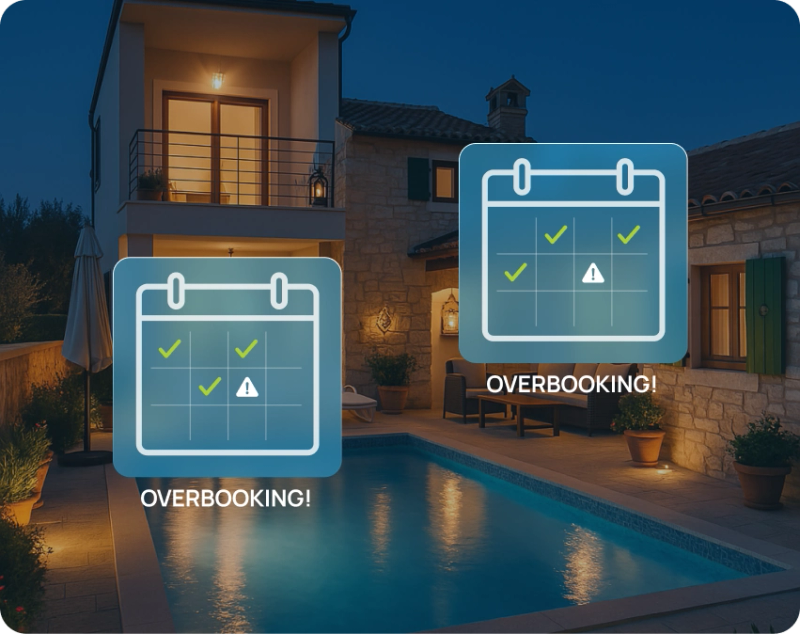
- Align prices and availability across all channels to reduce the chance of errors and overbooking.
- Check whether the guest can book on your website straight away and get real-time confirmation.
- Set up a Booking Engine and start increasing the share of direct bookings.
Conclusion
You cannot avoid the higher Airbnb fee, but you can reduce its impact on your earnings. Raising the price in a softer season often only makes sales harder. Instead, reduce your distribution cost and increase the share of bookings that come directly.
Rentlio One aligns prices and availability across all channels and lets you take direct bookings through your own Booking Engine. You still use Airbnb for visibility and new guests, while the direct channel helps you keep a larger share of the revenue.
More than 1,700 properties in the region already use Rentlio. Book a free review and see how much the new fee will really cost you and what you can do before 13 October.
Frequently asked questions (FAQ)
When does the new Airbnb fee take effect?
The final deadline for hosts in Croatia is 13 October 2026, but for some the new fee may take effect earlier, especially if they sync prices and availability through external software. So check your Airbnb notifications and email.
How much is the new fee and does it apply to everyone?
Airbnb is introducing a single 15.5% fee, paid entirely by the host. Until now the fee was split between host and guest, with the guest paying the larger part. The new model is being rolled out to almost all hosts, so it is worth preparing for the change in time.
Do I pay VAT on the Airbnb fee if I am not in the VAT system?
Yes. Private hosts who are not in the VAT system must calculate and pay 25% Croatian VAT on Airbnb's fee. That is why a 15.5% fee actually represents a cost of almost 19.4% of the booking value.
Do I have to raise my prices on Airbnb?
Not necessarily. Raising the price in a softer season can further reduce the number of bookings. Instead, keep a competitive price and increase the share of direct bookings, where the cost per booking is much lower.
Is it worth increasing the share of direct bookings mid-season?
Yes, but not by switching off OTA channels. Airbnb still brings you visibility and new guests, while a Booking Engine lets you take part of your bookings directly through your own website. Guests often check a property's website after finding it on an OTA channel, so you need to let them complete the booking there.


Daniel Herman is a growth marketing enthusiast with 10 years of marketing experience who enjoys thinking strategically and seeing the bigger picture. He writes about everything related to developing marketing activities and KPIs, branding, and taking a long-term approach to success, always with the goal of sharing useful ideas and inspiring action.