






What is a Hotel PMS? Complete Guide for Hoteliers 2026

According to the global 2026 Hotel PMS Impact Study by Hotel Tech Report, surveying 450 hoteliers, 89 % of hoteliers say their hotel PMS saves them between 2 and over 10 hours per week, and 91 % link the system directly to revenue growth. In the same study, 86 % of hoteliers rank the hotel PMS as the single most important system in their daily operations, ahead of the Channel Manager and revenue management systems.
The picture in our region is not much different. Internal research conducted at Rentlio Rediscover 2024 showed that 51 % of hoteliers in the region are not satisfied with their current technology, and 50 % do not believe they can stay competitive with it over the next 5 to 10 years.
A hotel PMS is no longer a back-office tool. It is the operational software through which reservations, guest check-ins, payments, communication, and reporting pass. A bad hotel system slows you down, a good PMS opens space for growth.

This is a practical guide through six topic areas: definition, functionalities, types, users, signs of obsolescence, and selection criteria. If you want a detailed cloud vs on-premise comparison, see our separate article on the differences between cloud and on-premise hotel PMS systems.
What is a hotel PMS and what are its main roles?
A hotel PMS is a central software platform that consolidates all hotel operations in one place. The industry uses several names for it: hotel PMS, PMS (short for Property Management System), hotel system, hotel information system, or hotel management software. All these terms describe the same thing, software that runs the front desk, sales, finance, housekeeping, and reporting through a single interface.
If you think of a hotel as a human body, the hotel PMS is the nervous system. Every signal, from a guest arrival at the front desk to a charge in the restaurant, passes through it and turns into an action: an availability update, an invoice, an eVisitor registration, or a management report.

The main roles of a hotel PMS are the following:
- Operational coordination: each department (front desk, sales, housekeeping, F&B) works from the same database, which eliminates double entry and errors.
- Centralized booking management: all bookings, regardless of source (Booking.com, direct, agency, walk-in), are handled from one place with automatic availability updates.
- Payment and invoicing: invoice issuance, fiscalization, payment control, and expense tracking, all in the same system.
- Guest communication: automated confirmations, check-in, communication, all recorded in the guest CRM.
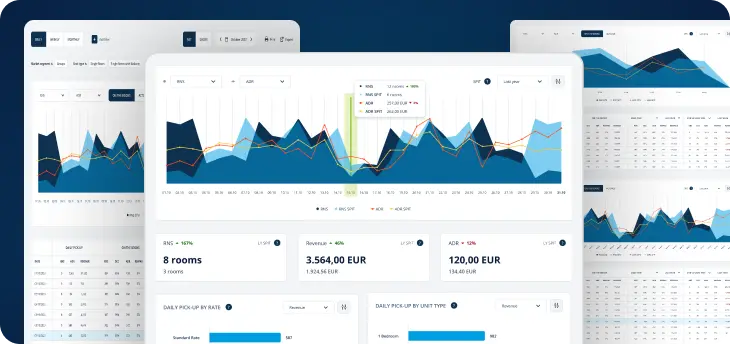
- Reporting and analytics: revenue, occupancy, ADR, RevPAR, pickup, booking sources, and other indicators in real time.
According to global data, 91 % of hotels worldwide use some form of hotel PMS, which makes it the most widespread software in the industry.
A hotel PMS is not an application "kept open at the front desk". It is the platform the entire hotel runs on.
What a hotel PMS covers: 8 key functionalities
A modern hotel PMS is no longer just a front desk program. It is a platform that integrates eight key functional areas:

- Booking management: entry, edits, cancellations, group bookings, splitting reservations, moving guests, all in one reservation calendar view.
- Room and availability management: room statuses (clean, dirty, out-of-order), inspections, room assignments, blocks, integrated with the housekeeping team.
- Check-in and check-out processes: fast guest registration in 30 seconds, document scanning, automatic eVisitor registration, invoice issuance on departure.
- Channel Manager: two-way synchronization of prices and availability with OTA channels (Booking.com, Expedia, Airbnb, HRS) in real time, without manual entry. For a detailed explanation of how a Channel Manager works, see here.
- Booking Engine: an integrated system for direct bookings from your own website, without OTA commissions. Rentlio users who actively use the Booking Engine generate up to 30 % more direct revenue.
- Guest communication: all communication with the guest (Booking.com messages, Airbnb messages, Expedia messages) is consolidated into one inbox inside the PMS, linked to the booking and the guest CRM. The front desk no longer opens 3 OTA channels to answer a guest question, everything is in the system with full booking context.
- Payment and fiscalization: automated invoice issuance, fiscalization in line with the Croatian Fiscalization Act, integration with payment processors like Rentlio Pay.
- Reports and analytics: revenue, occupancy, ADR, RevPAR, pickup, reports by market, market segment and room type, all in real time. For advanced reports, hoteliers also use Rentlio BI as a separate business intelligence layer.
A hotel PMS that only offers a front desk module and asks you to buy the Channel Manager separately no longer fits 2026 needs. Hotel Tech Report notes that 91 % of hotels globally use a PMS, but only 33 % have an integrated Channel Manager, which means most hotels still synchronize channels manually or pay for two systems in parallel.
If your hotel PMS does not include Channel Manager and Booking Engine in the core, you are paying for three systems and synchronizing them yourself.
Cloud or on-premise: two types of hotel PMS
Hotel PMS systems today come in two basic forms that differ fundamentally in installation, maintenance, and access.

An on-premise hotel PMS is installed on a local server in the hotel. The hotel owns the infrastructure, pays a license fee one-time or annually, and maintains the server, updates, backups, and security itself (or through an external IT partner). This is the dominant model for legacy systems installed 10 or more years ago.
A cloud hotel PMS does not require a local server. Data sits on remote servers maintained by the provider, and all the hotel needs is an internet connection and a device with a browser or app. The billing model is typically subscription-based (per room per month), and updates run automatically in the background.
Differences in practice:
- Access: a cloud PMS is accessible from any device and location, while an on-premise system requires physical presence at the front desk or remote desktop access to the server.
- Updates: a cloud PMS updates automatically, without interruption. An on-premise system requires planned downtime, usually at night or off-season.
- Costs: on-premise requires high upfront costs (hardware, license, installation) and ongoing maintenance. A cloud PMS has no capital expense, only a monthly subscription.
- Security: with a cloud PMS, security is part of the service, the provider implements standards like GDPR, PCI DSS, and ISO 27001. With an on-premise system, security responsibility usually sits with the hotel.
- Integrations: modern cloud systems have an open API and easily connect with dozens of other tools. On-premise systems often have closed architecture and complex integrations.
Market trends unambiguously show a shift to cloud. Hotel PMS market analysis shows that the cloud-based segment is one of the fastest-growing parts of the industry, while on-premise systems are shrinking.
We have given a detailed cloud vs on-premise comparison, with a table of differences across dimensions, in a separate blog on choosing a hotel PMS.
An on-premise hotel PMS is not safer than a cloud PMS. The safer system is the one someone maintains professionally, and with a cloud solution that is part of the service.
Who inside the hotel uses the hotel PMS?
A hotel PMS is not "front desk software". Almost every department in the hotel uses it, each in its own way and with different access rights.
- The front desk is the most intensive user. Guest check-ins and check-outs, booking changes, invoice issuance, eVisitor registration, guest communication. A modern hotel PMS reduces this whole process to a few clicks and brings the average check-in below 30 seconds.
- Housekeeping sees room statuses in real time (clean, dirty, inspection, broken) and updates them from a mobile device during the shift. The housekeeping manager tracks team productivity and assigns rooms.
- Sales and revenue management uses pickup, segment, and market reports to make decisions about rates and restrictions. Pricing strategies, packages, partner contracts, everything is managed through the system.
- Accounting pulls invoices and revenue data directly from the system, typically through an integration with accounting software. This eliminates double entry and reduces errors to a minimum.
- F&B (food & beverages) transfers charges from the restaurant or bar to the room, creates guest folios, tracks guest charges not tied to the accommodation.
- Management and ownership get reports in real time on any device. ADR, RevPAR, occupancy, pickup, all in a dashboard that opens in 3 seconds.
The key is in different access levels. A receptionist does not need to see margin reports. Accounting does not need to edit availability. The housekeeping manager does not need access to rate plans. A hotel PMS with serious role control and action logging ensures every employee sees and does exactly what is needed, no more and no less.
A well-configured hotel PMS solves both the operational and the control problem. Everyone sees what they need, nothing more, and everything stays recorded.
9 signs your current hotel PMS is no longer good and it is time for a change
The hardest question for a hotelier is not "how do I choose a new PMS", but "is my current hotel PMS still good". A legacy system often runs for years, the team is used to it, and nobody wants to open the conversation. These are 9 signs that clearly indicate it is time for a change.

- You cannot access hotel data outside the front desk: you cannot check occupancy from the car, from home, or on holiday.
- System updates require downtime: a system upgrade interrupts hotel operations, requires IT involvement, and in practice keeps getting postponed.
- No integration with modern tools: online check-in, digital signatures, connections to revenue management tools, none of it works or works badly.
- Too many separate communication tools: communication with the guest is scattered across 3 different OTA channels, the front desk has the Booking inbox, Airbnb messenger, and Expedia open. A single piece of information about the guest can be in any of them, and context gets lost.
- The Channel Manager is a separate system: you pay for two subscriptions and sync rates and availability manually, or the system runs it on its own but with a delay.
- The Booking Engine does not exist or converts poorly: direct bookings make up too small a share of total bookings, and you pay high OTA commissions.
- You pay for server maintenance and IT support: monthly infrastructure costs become a hidden part of your hotel PMS TCO.
- Reports are run manually: every Monday accounting exports data to Excel and assembles a report that should be ready with one click.
- The hotel PMS was installed more than 10 years ago and has not had a major upgrade: the software vendor promises an update that never arrives, or the last update was 3 years ago.
If you recognize yourself in three or more of these nine points, your hotel PMS is slowing you down. Hotel Tech Report finds in its research that 48 % of hoteliers would change their PMS vendor over reliability issues alone, regardless of the rest of the experience.
Moving to a modern cloud PMS is not a revolutionary decision, it is a natural step in the lifecycle of hotel technology. Read more about the process itself and why cloud is the present future on the Rentlio Pro hotel PMS page.
A current PMS that works but slows you down costs more than a new system that would speed you up. The cost just does not show up on the invoice.
How to choose the right hotel PMS: 7 key criteria
Choosing a hotel PMS is not an IT decision, it is a strategic decision that affects every hotel operation over the next 5 to 10 years. The following seven criteria filter serious candidates from the rest of the market.
- Cloud-native architecture, not a hybrid: a real cloud PMS is built for the cloud from the start, not a legacy system with a web interface added later. The difference is decisive in speed, integrations, and reliability.
- PMS, Channel Manager, and Booking Engine in the same package: the three components must be integrated, not separate. If you buy them from three different vendors, you yourself are the integrator.
- Open API and integrations with local systems: local accounting, fiscalization, restaurant POS, payment processors, housekeeping apps. All of this must be available through existing integrations, not as custom development.
- One place for guest communication: a hotel PMS that does not have a unified inbox for OTA messages forces the team to jump between tools. A modern hotel system consolidates all guest communication across OTA channels in one place.
- Mobile access for all departments: not just an owner app, but full mobile functionality for the front desk, housekeeping, and management.
- Local support in your language: global vendors have global pricing models and email support from other time zones. Local vendors respond within minutes and understand market specifics.
- Proven zero-downtime migration process: a hotel PMS that cannot be migrated in one week (5 working days) without interrupting operations is not a serious candidate. Ask for references, the number of migrations done, and the average migration time.
Rentlio Pro is developed exactly along these criteria. More than 150 hotels in the region have migrated from legacy systems to Rentlio Pro. Within one week (5 working days), the user can be fully ready for independent work, with data migrated, with no downtime. The system ran with 99.99 % uptime in 2025, has an NPS of 82, and an average support response time of under 2 minutes. For details on the platform, modules, and the migration process, see the Rentlio Pro page, or book a quick meeting with our specialists directly.
The question is not whether a hotel will move to a modern cloud PMS, the question is whether it will be done on its own terms or when the current system reaches end-of-life.
Frequently Asked Questions (FAQ)
What is a hotel PMS?
A hotel PMS (Property Management System) is a central software platform that runs all hotel operations, from bookings and the front desk to invoicing and reports. The industry also uses terms like hotel system, hotel information system, hotel program, or hotel management software, all of which describe the same type of solution.
What is the difference between a hotel PMS and a Channel Manager?
A hotel PMS is the central platform for running the hotel, from the front desk to reporting. A Channel Manager is part of the PMS (or a separate tool) that synchronizes rates and availability with OTA channels like Booking.com, Expedia, and Airbnb. A modern hotel PMS includes a Channel Manager as an integrated component, eliminating the need for a second system and manual synchronization.
Does every hotel need a PMS?
Yes. A hotel PMS is not reserved for hotels with 100 rooms or more. Hotels with 10 to 30 units already have enough complexity (multiple sales channels, fiscalization, eVisitor, reports) that running everything in Excel becomes risky and slow. A modern cloud PMS is affordable for smaller properties too and pays back already in the first season through time savings and fewer errors.
How long does migration from one hotel PMS to another take?
A proper migration to a modern cloud PMS takes one week (5 working days) with no interruption to hotel operations. The old system runs in parallel while the new one is being set up, data is transferred, staff is trained, and the hotel goes live only when everything is verified. Within this time the user can be fully ready for independent work, with data migrated. Rentlio has migrated more than 150 hotels to Rentlio Pro.
How much does a hotel PMS cost?
The price depends on the size of the hotel (number of rooms or units), the modules used, and the level of integrations. Cloud PMS systems are billed through a monthly subscription per room, with no capital expense. On-premise systems have high upfront license and hardware costs, plus annual maintenance. When you factor in total cost of ownership (TCO), a cloud PMS is typically cheaper already by the second year of use.
What is a cloud hotel PMS?
A cloud hotel PMS is a platform accessed over the internet, without the need for a local server in the hotel. Data is stored on secure remote servers maintained by the provider, updates run automatically, and the system can be accessed from any device. Cloud is the dominant model in the hotel industry today, and most new implementations are in the cloud.
Which is the best hotel PMS for hotels in Croatia and the region?
The best hotel PMS is the one that meets seven criteria: cloud-native architecture, integrated PMS, Channel Manager and Booking Engine, open API, mobile access, local support in your language, and a proven migration process. Rentlio Pro is built exactly along these criteria and is used by more than 150 hotels in Croatia and the region. For details and a tailored proposal, book a meeting.


Daniel Herman is a growth marketing enthusiast with 10 years of marketing experience who enjoys thinking strategically and seeing the bigger picture. He writes about everything related to developing marketing activities and KPIs, branding, and taking a long-term approach to success, always with the goal of sharing useful ideas and inspiring action.